
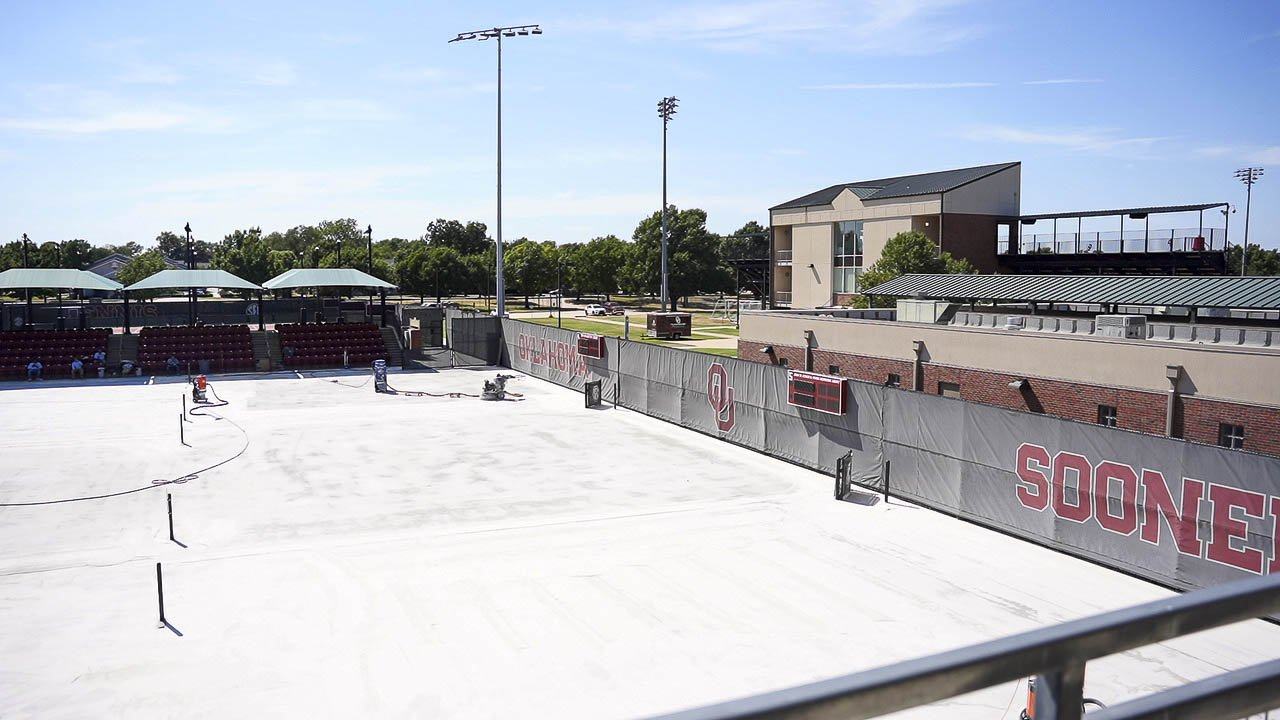
Three paths, in order of cost
- Resurface. Preparation, crack treatment, resurfacer coats, color and lines on the existing slab. Days on site. Public awards in our five states cluster between about $6,700 and $16,000 per tennis court for 4 to 16 court jobs. Budget guide.
- Overlay. A new post-tensioned concrete topping slab poured over the existing court, then surfaced. Denton ISD's 2026 co-op award for a 6 inch post-tensioned topping slab, surfacing, posts and fence work at Denton Ryan High School was $1,377,480; the proposal lists eight sets of net posts, which implies about $172,000 per court if it is eight courts (our inference, not the district's figure).
- Rebuild. Demolish and build new on a post-tensioned slab. College Station, Texas awarded $1.04 million in 2024 to demolish and rebuild six tennis courts on post-tensioned slabs with fencing and electrical conduit, about $173,000 per court. The City of Hope, Arkansas received four bids within 12 percent of each other, $1,095,700 to $1,225,631, for a three tennis and four pickleball court complex with parking in 2025.
Signs a resurface will hold
- Hairline cracks that do not move season to season and have no vertical offset across them.
- Surface wear, fading, chalking and worn lines; the slab itself is flat.
- Low spots that hold a thin film of water (birdbaths) that leveling can fill.
- A post-tensioned slab that has stayed in plane. On those slabs we grind the cracks, fill with a two-part polyurethane crack filler and grind smooth. We never rout hairline cracks; routing makes a bigger crack that needs yearly maintenance.
Signs the slab is the problem
- Cracks with a step across them, or that reopen every year after repair.
- Heaving or settling: a straightedge rocks, nets sag at one post, water runs the wrong way.
- Delamination: the old coating lifts in sheets. That alone can still be a resurface if the slab is sound, but it means taking the court back to bare concrete first. Coppell's Wagon Wheel courts are that case.
- Asphalt that has alligatored across most of the court, or a base that pumps when loaded.
The middle options
Between a resurface and an overlay there are crack membranes (a fabric or liquid membrane system bridging a crack under the acrylic) and localized concrete repair. In our proposals, standard crack filling is the normal process and a membrane is an extra step you can choose, priced separately so you are never buying the membrane to get your cracks filled. No public bid tab in our footprint prices membrane repair as its own line; owners buy it inside the resurface price.
How we decide with you
We look before we price. Send photos first; if the photos raise questions we walk the site with a straightedge and, on outdoor courts, a flood test. The proposal then names what the slab needs, what we will do about every crack, and what a resurface will and will not fix. If the honest answer is that a resurface buys you three years and an overlay buys you twenty, you will hear both numbers.
Why post-tensioned for the rebuild
A post-tensioned slab is held in compression by steel tendons, which is what resists the cracking that plain slabs develop in expansive clay soils across Texas and Oklahoma. Our Technical Director self-performs post-tensioned slab work. Post-tensioned concrete courts explained.
Questions
Can you resurface an asphalt court?
Yes, if the base is stable and the cracking is not structural. Asphalt courts with widespread alligator cracking are a rebuild conversation; we will tell you which after seeing it.
Will cracks come back after a resurface?
Cracks are a slab condition and surface work treats the symptom. Proper treatment keeps them closed and flat as long as possible; recurrence depends on slab movement. The proposal spells out what the workmanship guarantee covers.
How long does a rebuild take?
Concrete has to cure before acrylic goes down, so plan on roughly six to eight weeks from breaking ground to play for a straightforward build, longer for multi-court facilities with lighting and site work.
Sources
- Denton ISD, board consent item and Hellas proposal, August 2026: proposal, agenda item.
- City of College Station, TX, CSP 24-077 Bee Creek and Central Park tennis courts, October 2024: council preview, award report.
- City of Hope, AR, tennis and pickleball complex rebid, November 2025: solicitation.
- Coppell Chronicle, Vol. 6 No. 27, Wagon Wheel pickleball court repair award: article.
- American Sports Builders Association, Tennis Courts: A Construction and Maintenance Manual (2024 edition) and Pickleball Courts: A Construction and Maintenance Manual (3rd edition), on file at EliteTrax: sportsbuilders.org.